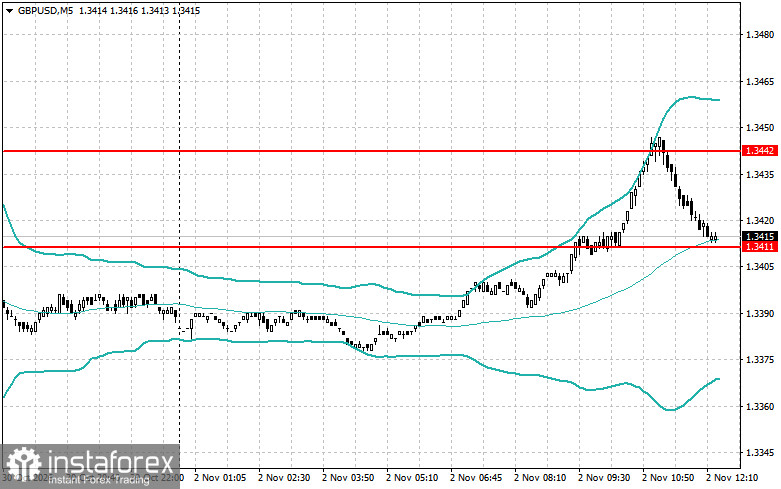
The pound started the week with a strong upward move but gave back almost half of its gains by midday. From a morning low near 1.3378, GBP/USD climbed to 1.3447 before slipping back to 1.3415.
British economic data released in the morning provided no reason for such a sharp advance. The October Manufacturing PMI came in at 52.8, exactly matching both analysts' expectations and the previous month's reading. This survey of factory executives and purchasing managers indicates expansion in manufacturing activity when the reading is above 50 and contraction when it is below 50. Since the figure held no surprises, it cannot explain the pound's advance. This is a good example of how, on a quiet day, a currency follows movements in the dollar rather than reacting to its own domestic news. The absence of negative news helped the pound hold its ground, but that was the extent of the support.
The next move will depend on the United States. The October ISM Manufacturing PMI will be released in the second half of the day. It is based on a survey of U.S. manufacturers, and the market pays close attention to it because it provides an early indication of the state of U.S. manufacturing ahead of official reports. The index is expected to reach 54.7, compared with 54.5 in the previous month. Particular attention will be paid to the price component, which shows how quickly the costs of goods purchased by manufacturers are rising. It is forecast at 77.2, compared with the previous reading of 77.9. If input prices rise faster, the Federal Reserve will have fewer reasons to cut interest rates, which would support the dollar. This would be negative for the pound, as it has no domestic catalysts to rely on today.
The second data release of the day concerns U.S. construction spending for September. An increase of 0.3% is expected, following a 0.9% rise in the previous month, indicating a notable slowdown. This indicator measures spending on the construction of homes, offices, and roads. It is sensitive to mortgage rates and therefore shows how the economy is coping with high borrowing costs. A weak reading would suggest that high interest rates are weighing on the sector and could give the pound some relief. A strong figure would support the dollar. The primary scenario is further pressure on the pound, as the pullback from the high has already begun, and a strong ISM reading could extend the decline.
Momentum
For the pound, the key resistance level is 1.3444. If the price consolidates above it, a move toward 1.3467 is possible, followed by 1.3492. The pair already moved above this level during the morning session, reaching 1.3447, but failed to advance toward the first target and quickly retreated. Therefore, this scenario should only be considered again after the price consolidates firmly above the level, rather than on the first test. Such a move would require upward momentum, potentially provided by a weak ISM reading.
The downside breakout level is 1.3409. If the price consolidates below it, the targets are 1.3379 and 1.3354. This is the preferred direction, as the current price of 1.3415 is only six points above the breakout level, and strong U.S. data could push the pair lower. The first target at 1.3379 is close to the morning low, where prices often pause or reverse. Therefore, beginner traders would be wise to take partial profits at this level.
Mean Reversion
For the pound, the upper reference level for a potential reversal is 1.3442. It is located just two points below the breakout level of 1.3444, making this area particularly prone to false signals. The morning price action already resembles a false breakout: the price moved above the level, failed to hold there, and then declined. If the pair rises into this area again, fails to consolidate above it, and quickly falls back below 1.3442, selling opportunities may emerge, with a stop-loss placed above 1.3467. However, if the price moves decisively above 1.3444 and continues higher, this would constitute a confirmed breakout, and selling against it should be avoided. This scenario appears less likely, as it would require weak U.S. economic data.
The lower reference level of 1.3411 is located just above the breakout level of 1.3409. The current price of 1.3415 is only four points away, so the zone is very close. If the price reaches 1.3411, fails to move below 1.3409, and then returns higher, buying opportunities may emerge, with a stop-loss below 1.3379. However, if the price consolidates below 1.3409 and moves toward the first target, buying should be avoided, as this would indicate a genuine breakout.
It is impossible to distinguish between these two scenarios based on a single test, and the difference may become clear within just a few minutes, particularly around the ISM release, when prices can move sharply in either direction. Therefore, the initial reaction will be avoided until the market direction becomes clearer. If the ISM reading comes in close to expectations, the market typically retraces after the initial spike. In that case, the mean-reversion scenario would become the preferred approach.