British Pound Trading Analysis and Trading Tips
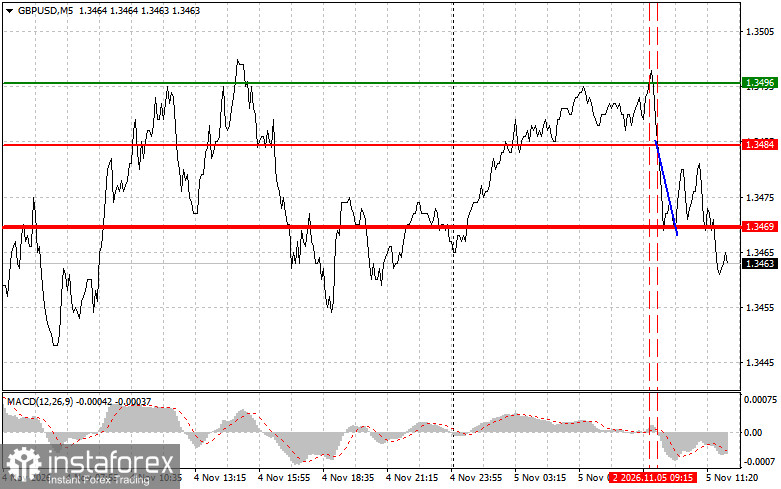
The price test at 1.3496 occurred when the MACD indicator had just started moving upward from the zero line, confirming a suitable entry point for buying the pound. However, the trade resulted in a loss, which was subsequently offset by selling at 1.3484, leading to a decline in the pair toward 1.3469.
The pound declined following disappointing UK economic data. The Construction PMI for October came in at 43.6, compared with a forecast of 46.4. The index stood at 46.1 in September and 44.3 in August, meaning that it fell even below the August reading. However, it is worth remembering that the Bank of England is expected to raise its interest rate today to 4.0% from 3.75%. Seven committee members are expected to vote in favor of the increase, compared with three in September. This outcome has already been priced into the market, while weak construction data only adds to uncertainty about how far the regulator is prepared to go with monetary policy tightening.
Although the UK economic agenda has yet to run its course, weekly US initial jobless claims data will also be released in the second half of the day. The forecast stands at 197,000, compared with 194,000 a week earlier. The figure remains near its lowest levels, indicating that companies are still reluctant to lay off employees. Continuing claims are forecast at 1.71 million, compared with 1.70 million previously, suggesting little change. Strong figures could support the US dollar, although a significant downside surprise appears unlikely. More importantly, FOMC members Beth Hammack and Thomas Barkin are scheduled to speak. Hammack previously advocated a restrictive monetary policy and voted in favor of a rate hike at the latest meeting. The market expects her to maintain this hawkish stance. The dollar currently needs precisely this kind of support, as it has weakened following the elections, while US Treasury yields have declined.
Regarding the intraday strategy, the focus will primarily be on implementing Scenarios No. 1 and No. 2.
Buy Signal
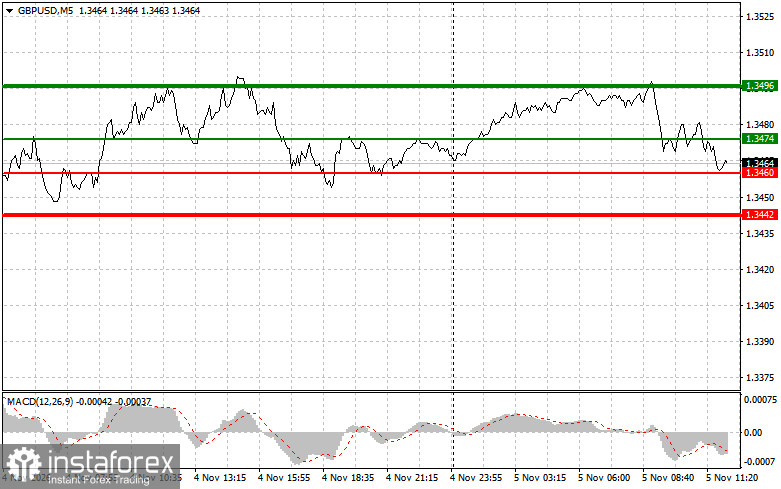
Scenario No. 1: Buying the pound today is planned if the price reaches the entry point around 1.3474 (the thin green line on the chart), with a target of 1.3496 (the thicker green line on the chart). Around 1.3496, the long position will be closed and a short position opened in the opposite direction, targeting a reverse move of 30–35 points from this level. Further gains in the pound today are possible if US economic data comes in weaker than expected. Important! Before buying, make sure that the MACD indicator is above the zero line and has just started rising from it.
Scenario No. 2: Buying the pound today is also planned if the price tests 1.3460 twice consecutively while the MACD indicator is in the oversold zone. This would limit the pair's downward potential and trigger an upward market reversal. A rise toward the opposite levels of 1.3474 and 1.3496 can be expected.
Sell Signal
Scenario No. 1: Selling the pound today is planned after the price breaks below 1.3460 (the thin red line on the chart), which should lead to a rapid decline in the pair. The sellers' main target will be 1.3442, where the short position will be closed and a long position immediately opened in the opposite direction, targeting a reverse move of 20–25 points from this level. Strong selling pressure on the pound could return if US economic data is positive. Important! Before selling, make sure that the MACD indicator is below the zero line and has just started declining from it.
Scenario No. 2: Selling the pound today is also planned if the price tests 1.3474 twice consecutively while the MACD indicator is in the overbought zone. This would limit the pair's upward potential and trigger a downward market reversal. A decline toward the opposite levels of 1.3460 and 1.3442 can be expected.
What the Chart Shows:
- Thin green line – the entry price at which the trading instrument can be bought.
- Thick green line – the estimated price at which Take Profit orders can be placed or profits can be closed manually, as further gains above this level are unlikely.
- Thin red line – the entry price at which the trading instrument can be sold.
- Thick red line – the estimated price at which Take Profit orders can be placed or profits can be closed manually, as further declines below this level are unlikely.
- MACD indicator. When entering the market, it is important to consider the overbought and oversold zones.
Important. Beginner Forex traders should exercise extreme caution when making market entry decisions. It is preferable to stay out of the market ahead of major fundamental data releases to avoid exposure to sharp exchange rate fluctuations. If trading during news releases, always place stop-loss orders to minimize potential losses. Without stop-loss orders, the entire trading account balance can be lost very quickly, especially when money management principles are not applied and large position sizes are used.
Remember that successful trading requires a clear trading plan, such as the one presented above. Making spontaneous trading decisions based on current market conditions is inherently a losing strategy for intraday traders.